Looking Back at u-lab: 12 Editions, Over 10 Years
Supporting Changemakers around the Globe since 2015
Contributing Authors: Dayani Centeno-Torres, Katherine Kearney, and Caspar Scharmer
2026 will be u-lab’s last season in partnership with MIT’s open learning initiative—MIT Learn. Eleven years after u-lab first launched, it has grown to reach more than 260,000 participants across 194 countries, self-organized into more than 2,000 hubs worldwide.
What the momentums fostered by u-lab become next, lies at the core of the seeds that have been nurtured through over a decade. As an organization, team, and global community we are sensing into and beginning to co-imagine that now. This season of transition comes at a moment when the capacities u-lab was built to cultivate – deep listening, presence, the ability to sense what is wanting to emerge matter more than ever. So, as we begin to look to the future, it's also worth reflecting on what the past decade of u-lab has actually cultivated.
In 2015, Otto Scharmer, Senior Lecturer at MIT and founding chair of the Presencing Institute, along with Adam Yukelson and in collaboration with Kelvy Bird, Dayna Cunningham, Arawana Hayahsi, Julie Arts, and Katrin Kaufer, co-created u-lab as a free, open online course. Built in partnership with MIT, u-lab was designed differently from a typical online course: rather than one instructor teaching many students, it worked as many-to-many, inviting participants to form their own local "hubs," often as simple as a few friends meeting in a living room, sometimes as large as a city-wide network convening in available public meeting spaces, but always connected into the larger, global, decentralized network.
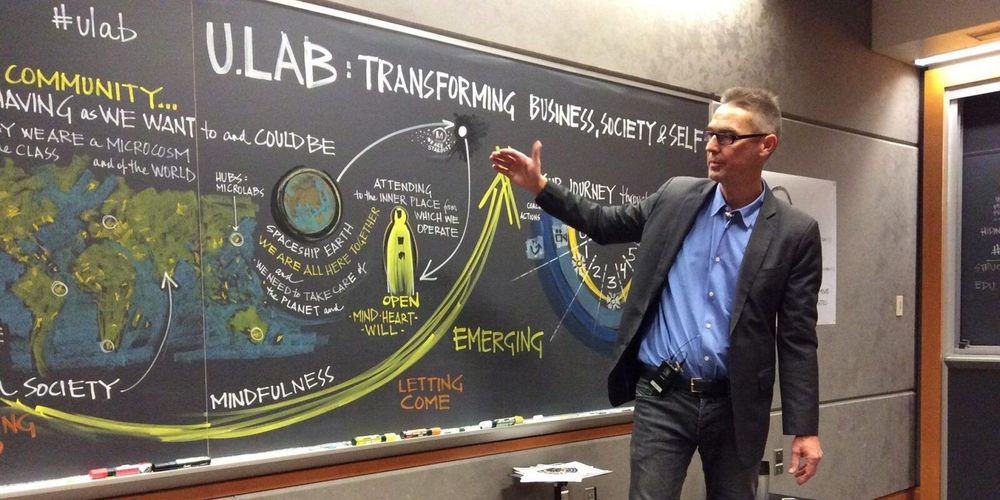
Otto Scharmer during a live session
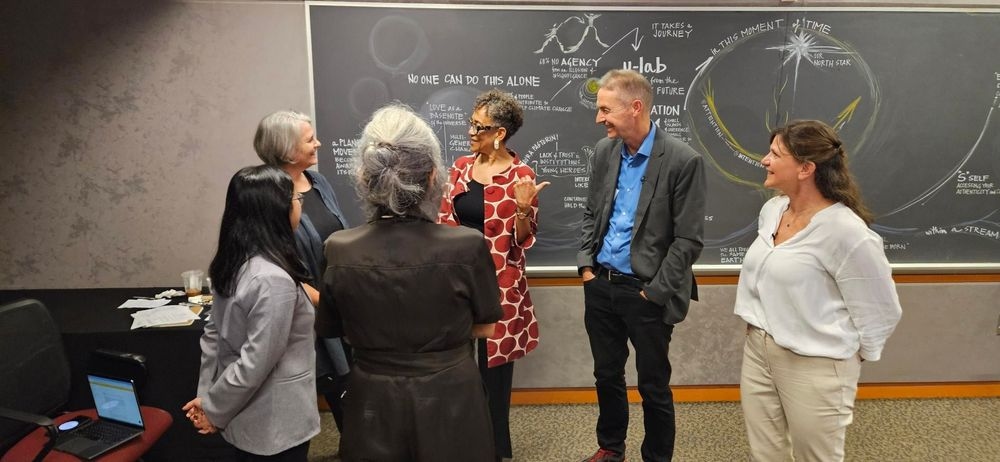
The team after the live session at MIT
Salvador Pérez, in Spain, is one of the people who found a before-and-after experience in u-lab. Through the hands-on, learning by doing approach, he was inspired to co-create Albal Circular, a community compost project that now manages around 8 tons of organic material with the collaboration of roughly 500 individuals, businesses, and educational centers in Albal, Valencia. Looking back at what led him there, he says:
When systems crack and old certainties crumble, you need to connect with your inner knowing — sometimes very faint — that connects you to a hope on the horizon, to the emerging future of possible transformation. And you need the practices and people to help realize that possibility."
That's the pattern that repeats across years of u-lab: someone at a threshold, a set of practices, and something concrete built afterward. Course materials have been translated by scores of volunteers to support individuals, organizations, and communities across the globe. Through the evolutions of each year’s cohort, u-lab has become a learning ecosystem shaped by thousands of lived experiences like Salvador's.
The world keeps changing, so we went back and looked at over a decade of participants' survey responses. Using a mix of manual review and AI-assisted thematic analysis, we traced patterns, shifts, and recurring signals across years of learning journeys.
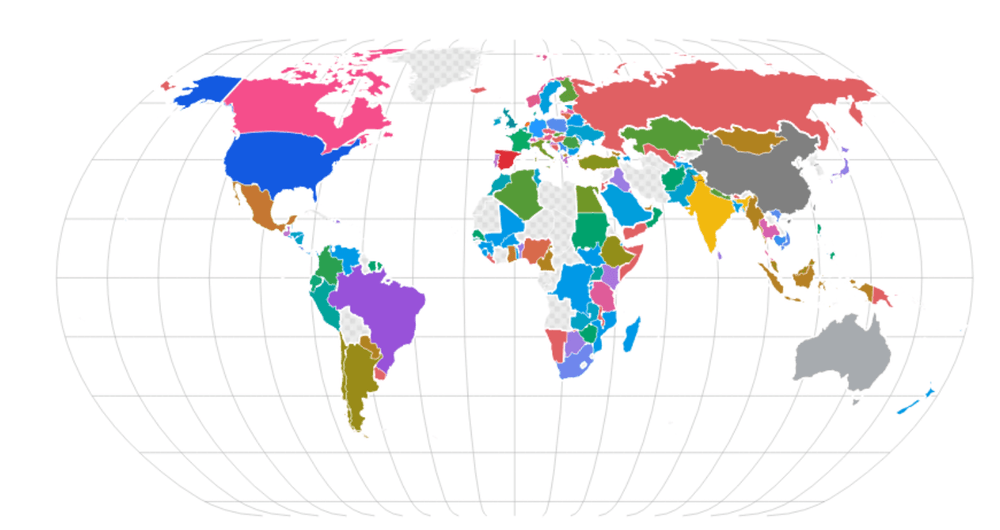
Where peeople join from
Who Is Our Community?
One of the first things that becomes clear in the data is just how diverse this learning field is. Participants are at every stage of life: young adults searching for direction, mid-career practitioners navigating complexity, seasoned leaders looking to reconnect to purpose.
Geographically, the field stretches wide. Participants come from Europe (39.5%), North America (27.7%), Asia-Pacific (17.2%), Latin America (11.6%), and Africa (4.1%). The United States, Germany, Brazil, India, and the Netherlands consistently form the largest country groups, with participation increasing across Latin America, India, and parts of Africa.
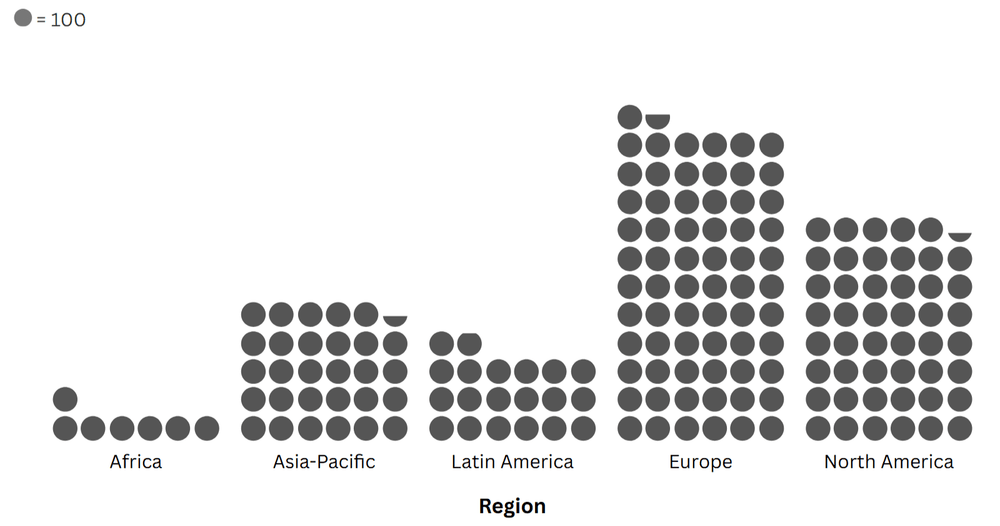
Participants by region
A key trait among participants is that they tend to arrive at threshold moments in their lives, a point where their old ways of working, of navigating change, start to feel inadequate. The two biggest areas of learning they report fall into inner presence and collective community. Marie Hernandez summarized this in a comment via LinkedIn (2026):
I’ve learnt so much about myself and how to truly slow down to speed up. It has allowed me to create awareness of self and to facilitate this for others in terms of what is occurring within our human ecosystem at an individual, organisational and societal level."
The sectors participants come from are just as varied: social entrepreneurs make up the largest group (35%), followed by business professionals (23%), educators (14%), and public-sector innovators, healthcare workers, and grassroots leaders. It's not the centers of power that arrive at u-lab first, it's the edges, the places where new things are already starting to germinate.
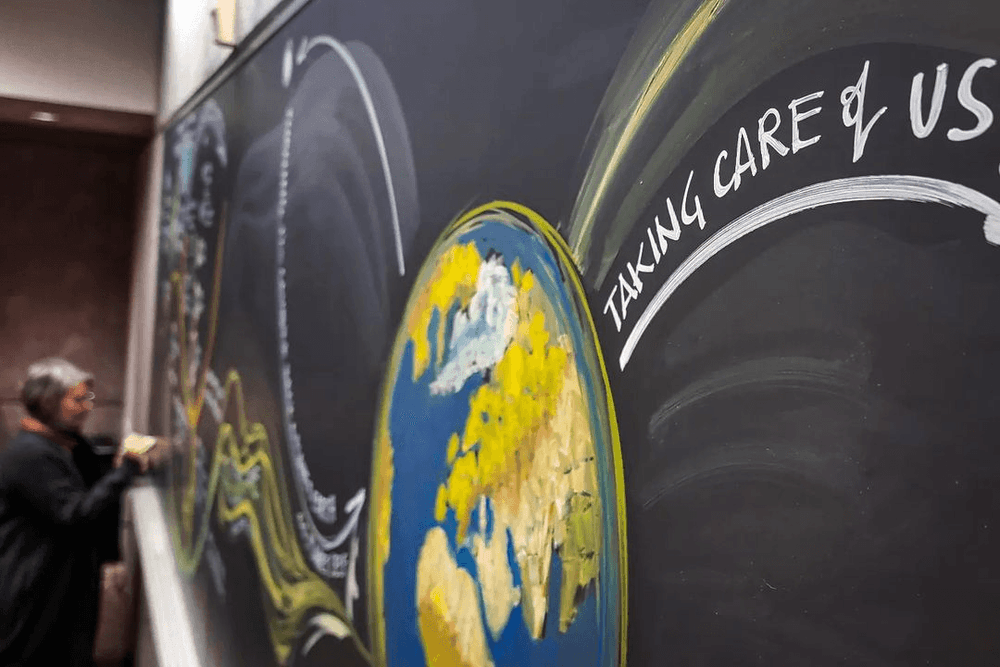
Kelvy Bird scribing at MIT
u-lab as a Life-Changing Experience
Across over a decade of surveys, almost 33% of respondents call the u-lab experience life-changing. In every cohort, thousands of people describe a fundamental reorientation in how they understand themselves and their systems, leaving with a renewed sense of purpose, a more grounded presence, and the courage to act from possibility rather than fear. Salvador's story, in that sense, isn't unusual, it's representative.
One faculty member who taught the course in 2016, Martin Kalunga-Banda, went on to co-found Ubuntu Lab in Africa the following year, one of several organizations that grew directly out of u-lab's community.
What changes, specifically? The data points to a shift across four mindset domains:
- Nearly 85% say they are able to see their situation or the world in fresh and more perceptive ways.
- 82% describe a stronger ability to understand systemic complexity from multiple viewpoints.
- 82% report that they can draw more effectively on head, heart, and hand to inform decisions.
- 67% say they can identify the deeper, often hidden dynamics influencing a system.
Mindset shifts don't just stay in people's heads, they also show up in how people relate to each other. Participants describe a shift in the quality of their listening, and in their ability to hold space for others, and for the unknown:
- The most common change people report after u-lab is bringing deep listening into daily life.
- The second most common is launching something new, an initiative, a project, a prototype, at work or beyond it, the same move Salvador made when he turned what he'd learned into Albal Circular.
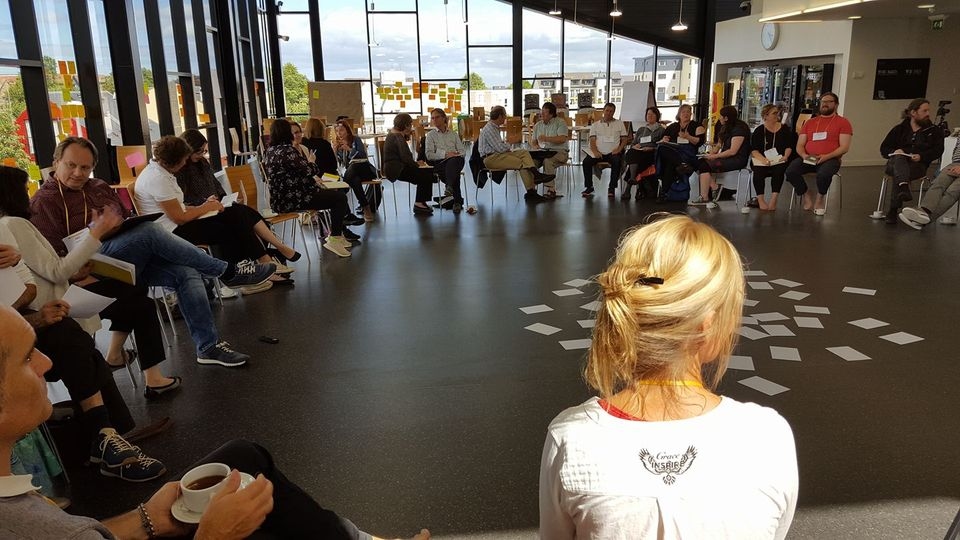
u-lab Hub Netherlands
Community as a Catalyst
At the Presencing Institute, we consider participation in hubs and coaching circles to be some of the clearest indicators of u-lab’s social field health over time. In case you’re not familiar - hubs are self-organized groups, based on shared location or interest, that meet in person or online to practice the methods and tools; coaching circles are groups of 5-6 people who meet weekly to explore leadership challenges using the Case Clinic tool.
Hub participation peaked early, dipped during periods of global fatigue, then surged again after the pandemic: 49% in 2022, 62.7% in 2023, 68.2% in 2024. u-lab functions as a place people return to, the "social soil," where they can land, connect, and rebuild resilience.
One of the first hubs started in Portland, Oregon, the same year u-lab launched. Stephanie Fleming co-hosted it in 2015, using Theory U's practices to facilitate large stakeholder groups that had struggled, until then, to collaborate, with what she describes as transformative results. The hub connected local changemakers to u-lab's global network, and more than a decade later, it's still running. "This u-lab is free," she says now. "If there isn't a local hub near you, and you don't want to start one, there are many virtual ones you can choose from. I highly recommend the experience, " she offered via LinkedIn.
Coaching circles work at a smaller scale. Gemma Jiang, PhD, who has hosted them for seven years, wrote about the format in a February 2026 article, describing it as a space where vulnerability is safe and empathy is abundant:
A coaching circle has become the place where I meet ghosts from the past, face tensions of the present, and articulate possibilities for the future — in the presence of others who are doing the same.”
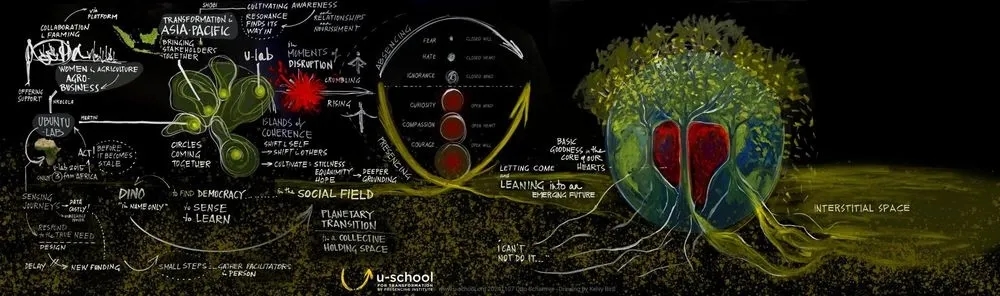
Scribing by Kelvy Bird
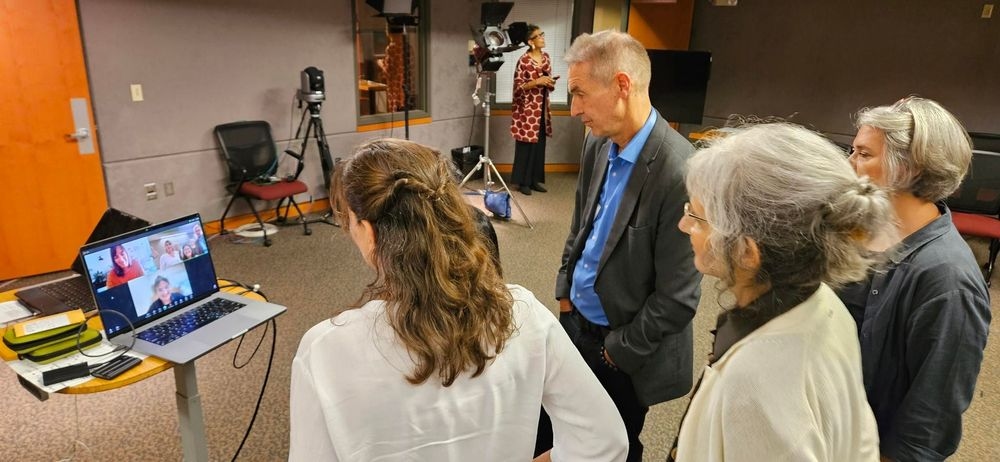
The on site team debriefing with the virtual team
The Future of u-lab
We look at this transition as a new opportunity to respond to new needs and circumstances by listening to the social soil.
Our commitment to free access to the tools is still there. Our conviction of the possibility of a beautiful future for humanity and the planet has not changed. We envision u-lab will evolve to be responsive to new challenges: focusing on qualities of leadership needed today, and nurturing the social soil to invite in grounded presence and courageous action.
As we open the 2026 edition on September 10th, we extend an invitation:
- Come stand at the threshold with us.
- Sense what wants to emerge.
- Take your place in shaping the future of your system and of u-lab.
- If someone comes to mind as you read this—someone standing at their own threshold—consider passing this along.
u-lab 2026 opens September 10th. It remains free, and open to anyone—whether this is your first season or your tenth. Registration and details: u-lab.org
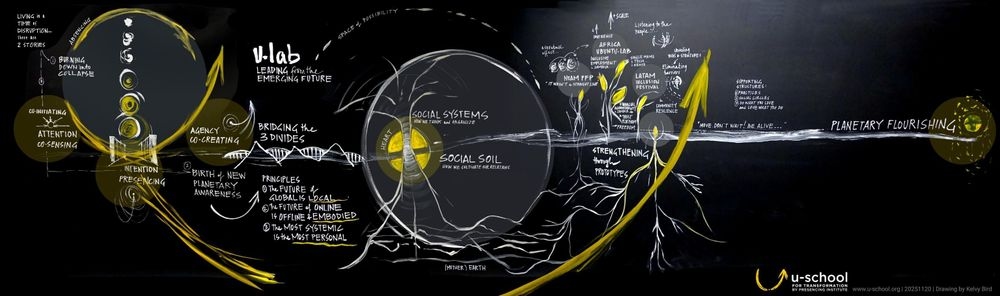
Scribing below by Kelvy Bird.