Tending to the Fire Together
“Prototyping means sustaining intention without forcing results”
As we approach the final sessions of the Presencing Series and Regenerative Futures Labs, here is a reflection on prototyping by a participant of the Ecosystem Leadership Program in LATAM.
Pedro Pérez Guillón has ancestral ties to the Maipo River near Santiago, Chile. His family has been connected to the Cajón del Maipo area for generations—one of the most important regions for the protection of flora, fauna, and water conservation in Chile's Central Zone.
On its journey from the mountains, through the Santiago metropolitan area, to its mouth in San Antonio, the Maipo River is the main source of drinking water for more than 8 million people living in Chile's capital. Along the Maipo, there are numerous mining sites, large-scale hydroelectric projects, landfills, urban expansion initiatives, and unregulated tourism ventures that affect the health of its ecosystem. Chile is predicted to be the country with the highest water stress in the entire Western Hemisphere in the coming years. This has already caused enormous damage to ecosystems: droughts, fires, floods, losses of more than 50% of biodiversity, and a growing vulnerability to the future of the basin.
For Pedro and his community, the urgency of understanding, conserving, and restoring the Maipo basin and its entire bioregion is clear. From this clarity, an intention emerged: the Maipo Sanctuary, a catalyst for restoration and regenerative development at the bioregion scale—an idea Pedro took into the Ecosystem Leadership Program / LATAM for further evolution. As a seed idea, the Sanctuary is still emerging. We asked Pedro for insights on the process of prototyping, his personal leadership journey and key lessons.
1. How would you describe the initial idea?
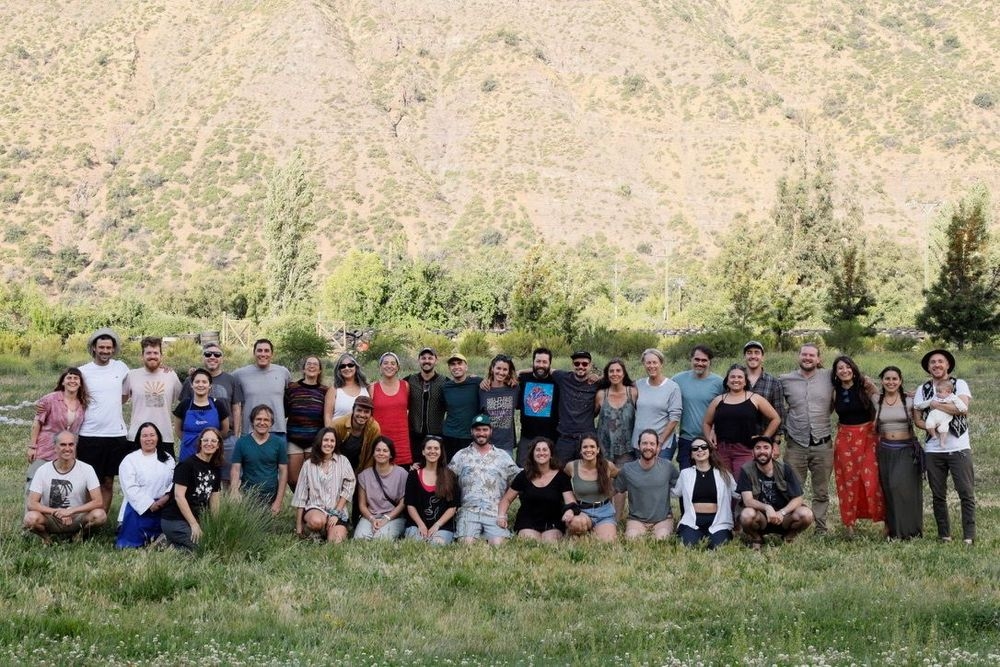
Our first vision was co-creating a space for learning, transformation, and regeneration in nature. Over time, this evolved into a BioHub (Santuario del Maipo). The idea of the BioHub allowed us to consider some intentions on different scales that existed in the social field. Several of us from the LATAM Ecosystem Leadership Program had been talking about the need to create a regenerative network in Chile and Latin America. A social fabric around regeneration with the idea of creating a common platform where we could visualize, connect, and coordinate our efforts at the watershed or regional level. This would generate a portfolio of projects, a network for collaboration and learning, and a comprehensive restoration plan at such level. With this idea in mind, and with support from Presencing Institute and Commonland, we convened a first meeting at the Maipo Sanctuary, called “Weaving Regenerative Bioregions”.
2. What have been some of the leadership challenges you have faced along the way?
- Patience and presence: Knowing that it is not about pushing for change, even though sometimes the future you want is clearly visible. Reaching the envisioned horizon still involves walking a stretch within the current landscape, sustaining the intention without imposing the outcome.
- Aligning external and internal transformation: You are learning to live in two paradigms simultaneously. This can be exhausting. A supportive community is not just an accessory, but fundamental to sustaining trust, resilience, and continuity in the process.
Internally, the challenge is to trust despite systems’ natural resistance to change, and to develop the ability to remain present without falling into reactive or mechanical action. Transformation does not happen by forcing, but by creating conditions for the system to find its own movement. - Learning to make peace with the economic dimension of change: We often sustain our work through the inspirational value and ecological, social, and cultural impact of what we do. However, transformation also requires financing, and it is not always easy to integrate the economic dimension as legitimate and consistent with our values.
3. What tools or practices from Theory U have you found valuable in the process?
In the end, it is not the tool that transforms the system, but the quality of presence and listening from which a community puts itself at the service of the future that wants to emerge. That said, for me these are fundamental tools:
- The levels of listening. Deep listening offers a possibility for self-awareness that can generate a profound change in the dynamics of any process or relationship and can be exercised at any time, even when I am alone.
- Social Presencing Theater. SPT, as a form of somatic knowledge, both on a personal and collective level, allows us to develop self-awareness about our blind spots. 4D and 3D Mapping have been key to observing the system from new perspectives.
- The community of leaders of change. Although it is not always recognized as a tool, one of the most valuable resources of the Presencing Institute is its global and local community of changemakers. Having a human container aligned with a shared ethic and vision has been fundamental. I don't know if, otherwise, I would have been able to sustain the confidence, hope, and energy necessary to walk the often-lonely path of systemic change.
4. What has changed in you, in your leadership role through the journey?
I feel that my fear has diminished and my confidence has grown. I feel less alone and less attached to results, trusting more in the process and in what wants to emerge through it.
It is no longer about my struggle, but about what we feel we need as a collective, about the potential that seeks to manifest itself from the common field. I have moved from a more individual view of leadership to a more systemic and collective view; from a more anthropocentric perspective to a more biocentric one; and from a short-term approach focused on expected results to a more long-term understanding, focused on the new that can emerge from a process of transformation.
I no longer feel the need to have all the answers. We do not lead change from what we know, but from the quality of presence with which we listen, feel, and allow ourselves to be transformed by the future that wants to emerge.
I have come to understand that things flow when energy moves in that direction. It is not about constantly pushing, but about perceiving what is trying to emerge from the social field and putting oneself at its service.
5. What would you recommend to those who are about to start a prototype?
- I invite you to observe the process and let go of your attachment to the results. Be mindful of your energy. Does it come from agitation? Fear? Don't fall into the usual pattern of mindless action. Move away from the logic of quick fixes and into the logic of profound transformation.
- Learn to trust the process. I believe that it is the processes and the place from which we do what we do that we are really prototyping, not the external products. It is about trying, together, to build a new operating system, a different place from which to operate. Prototyping is not just a “technical result”; it is a process of inner and collective transformation. Prototyping shapes us as much as we shape it. It is an opportunity for learning, self-knowledge, and mutual care.
- Believe in the power of the seed that each of us feels within ourselves and that we feel collectively in the social field. If you sustain this incubation, which can be dark and lonely at times, when the time comes for the first shoots to emerge to the surface, help will come from outside.
- Don't prototype from the head alone; integrate the heart. Prototyping is learning with the world, putting what emerges into play and listening to the system's response. It is a process of weaving together harmonies. When we stop controlling and put ourselves at the service of what wants to be born, leadership becomes a natural expression of collective intelligence. It is not about us. And that is deeply liberating.
- Finally, I invite you to feel and trust in the regenerative force of life, of which we are all a part and to which we are connected by an invisible mycelium of common meaning and direction.