What Is Mine to Do?
Cultivating the Social Soil for Regenerative Futures
Regenerative Futures Lab Session 1 Recap
April 23, 2026
Over 580 changemakers gathered globally for the first Regenerative Futures Lab session, continuing the co-sensing work of Presencing Series 2026. Where the first two sessions highlighted specific planetary challenges through featured guests, this session invited the community to step forward and hold conversations on the concerns, inquiries, and possibilities most important to them.
Through Open Space methodology, participants self-organized into 80+ breakout dialogues across multiple languages, creating what one participant called "islands of peace" where weak signals could become visible and collective agency could emerge.
We See You
Martin Kalungu-Banda opened by welcoming the global community—from Africa to South America, North America to Europe, the Middle East to Asia—naming not just geographies but the fullness of what each person brought:
"We welcome your excitement and your fears. We welcome your wide eyes and open hearts right alongside your doubts... We welcome you with the knowledge you bring. We welcome you in your ignorance. We welcome you in your privilege. We welcome you in your grief of the suffering of many people across the world, and the suffering of Mother Earth."
The welcome recognized that "our time is also filled with enormous transformative potential."
What Does a Regenerative Future Mean?
Before diving into dialogue, Eva Pomeroy grounded the session in its core question: What does a regenerative future mean to you?
Participants had submitted VideoAsk responses, and a montage of voices opened the space:
"A regenerative future, to me, means moving beyond extraction and ending the exploitation of our planet. It's about designing systems with circularity in mind, where nothing becomes waste, and everything has a purpose."
"A regenerative future for me is a return to our essence, to the earth, to life and love. We remember we are part of this living web, interconnected with all beings."
"For us, regenerative futures really means something where we can have reconciliation with, for example, the Indigenous people here in Vancouver, Canada, and also perhaps around the world."
"It is local, community-led, and deeply human."
"It's about deep, personal change, and it also brings deep change to the systems around us."
"A regenerative future starts now. It is not some future point, it's how we live, how we are, what we do now."
Three Strokes: Your Agency, Emerging Future, Social Soil
Otto Scharmer offered three essential framings:
You're in the center. "Your agency is in the center of the emerging future. And in many ways, what it is that we are called to do now, and what it is what we are going to do, and how we show up, is the only thing of interest."
Sensing the emerging future. "What is the emerging future? It is a field of possibility that looks at me because it depends on me to manifest... It's not going to happen without us, without us showing up and stepping up into our agency."
Cultivating the social soil. "The soil is a thin, fertile layer... that allows us to recompost the old and to nurture the seeds and the shoots of the new. And we all know we live in this in-between space. Something is ending and dying, and something else is wanting to be born, and we are the ones who are just in between."
Otto led a grounding practice connecting participants to feet (touching the same planet from different places), heart (500 here now, connected to so many more), and head (the space of possibility looking at us).
The question: "What is ours to do? What is mine to do?"
Vertical and Horizontal Prototyping
Martin Kalungu-Banda introduced a crucial distinction: "There are always two sides to every prototype. The vertical and the horizontal."
"Sometimes we tend to focus on the horizontal, because it's out there. It's the project, it's the initiative out there. But quite often, there is the other side, the vertical prototype. I am the system."
"The work on the self is almost primary to the horizontal prototype, the work out there. And that's why we gather like this—so that we can sharpen our tools for open-mindedness, open-heartedness, open will."
80+ Conversations
After journaling on what brought them and what's calling them, 500+ people self-organized into 80+ dialogues. Topics ranged from youth and disruption to regenerative development goals, from community and ego to weak signals and collaboration.
The Harvest
Powerful themes emerged:
Regenerative leadership as creating conditions for every community member to thrive, not leading from ego.
Children's futures where parents extended their care beyond their own children to all young people, even as society often pits parents against each other.
Generative listening creating "islands of peace" even in short online conversations with strangers.
Spotting the weak signals of a regenerative future is easier together — what if 500 people pooled what they each notice, instead of seeing only their own small piece?
Radical trust and abundance: "Do what you can, with what you have, where we are. Like, that's it, you know?"
The question provocation: Does regeneration always require crisis? Can we provide a better way?
Co-creating with life itself: aliveness, vitality, creativity.
Visual Resonance
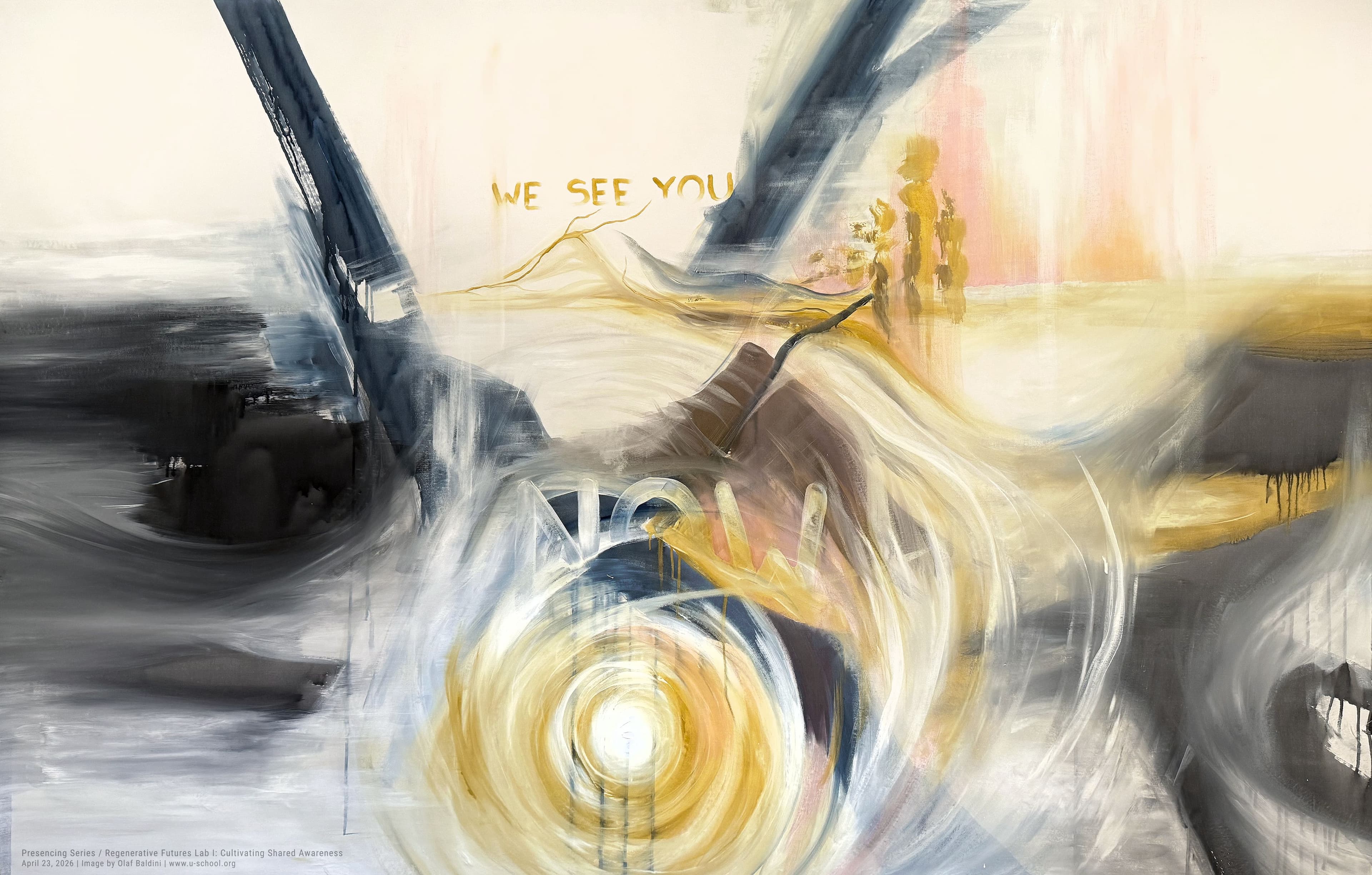
Olaf Baldini's live scribing captured the field. When participants looked at the image in stillness, they saw: the future is now and within us, torches lighting our future, being seen, the power of now, fearlessness, presence, light.
The Invitation
Eva Pomeroy closed: "Such a busy time, these are such busy times, and you've chosen to be here in this community today. We're grateful."
Otto reflected: "I love this, Patricia—do what you can with what you have where you are. Such a wonderful articulation of the spirit that we try to embody and strengthen here."
The future is looking at us. It depends on us to manifest. And 580 seeds just began sensing together what wants to emerge.
For session recording register and watch here.
You can find the stand alone "What Does a Regenerative Future Mean?" clip here.
Scribing below by Olaf Baldini.