Deep Data: Can AI Help Us Grow Wiser?
A reflection by Nipun Mehta, founder of ServiceSpace.org
Adapted from an original essay by Nipun Mehta, founder of ServiceSpace.org, this piece reflects on what it means to be human in the age of AI. His work at the intersection of technology and heart intelligence finds a natural resonance with the Presencing Institute's own exploration of social soil and collective emergence.
Deep Data: Can AI Help Us Grow Wiser?
A reflection by Nipun Mehta, founder of ServiceSpace.org
What does it mean to be human at a time when machines can write, diagnose, compose, and pass the bar exam? This is the question Nipun Mehta sits with in his remarkable manifesto — and his answer has stayed with us long after reading it.
Nipun is not afraid of AI. He is afraid of what we might forget in its presence: that wisdom lives in the body, in relationship, in the quality of attention we bring to each other. That the most important knowing cannot be captured — only circulated. That what the forest has known for four hundred million years, we are just beginning to remember.
This is the same territory the Presencing Institute has been tending for over two decades — and why we were moved to share Nipun's words with our community. His manifesto is a gift to anyone asking not just how we navigate this moment, but who we need to become to do so wisely. That conversation continues in the Presencing Series — and Nipun will join us for Session 2 on April 2, 2026, Reclaiming Human Agency: Navigating AI, Social Fracture, and Polarization, alongside Manish Srivastava, with co-hosts Otto Scharmer and Antoinette Klatzky, and Social Artist Kelvy Bird.
"Here is the unexpected gift of this moment: much of what we called 'thinking' was pattern matching all along. This is what ChatGPT has demystified. It compresses the internet into predictions. It distills patterns into lines of best fit. And it turns out this is enough to write code, diagnose illness, compose music, and pass the bar exam. This is humbling. But it is also clarifying.
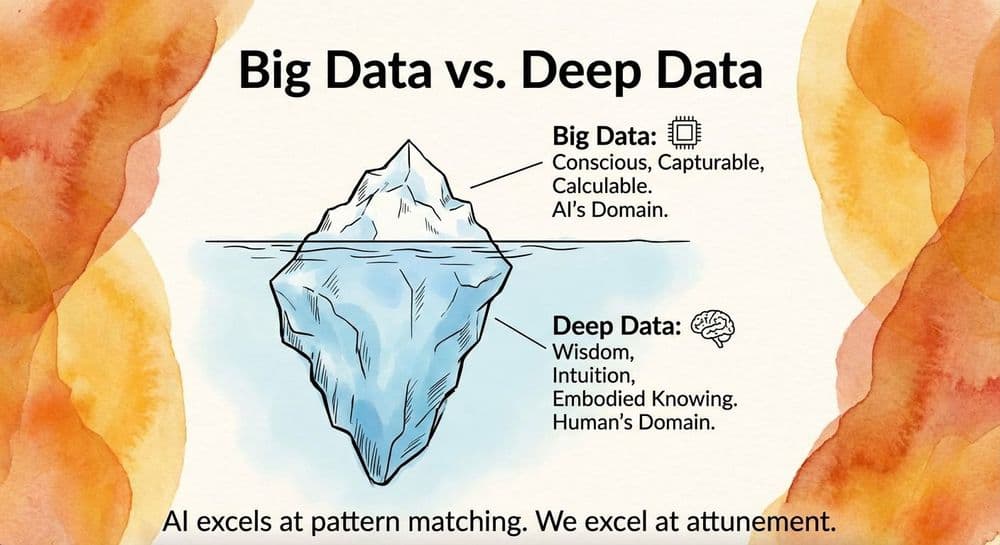
AI excels at what we might call big data — the conscious, capturable, calculable information that lives on the surface of our lives. Every click, every purchase, every word we type. Machines can find patterns in this data that no human could see.
But there is another kind of knowing. Call it deep data — the wisdom encoded in our bodies, our intuitions, our unconscious processing. The gut feeling that something is wrong arrives before the reason why. Your heart knows before your mind does.
To be precise: deep data is the form of intelligence that emerges when many signals — bodily sensation, emotion, memory, social context — integrate faster than conscious thought. It is the accumulated wisdom of a system that has been listening to itself for a long time.
We already rely on it constantly: when a skilled surgeon 'just knows' where to cut, when a parent senses something is wrong before evidence appears, when a team feels misalignment before metrics confirm it. AI can model the outputs of these judgments — but it does not inhabit the conditions that generate them. Deep data isn't accessible through algorithms. It's accessible through attunement."
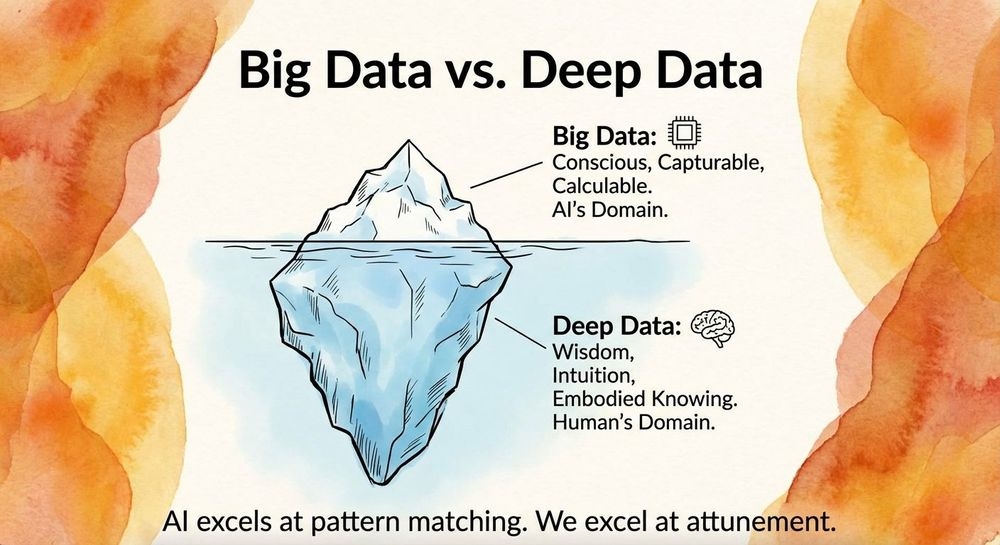
We access deep data through presence, heart intelligence, and the alignment of breath, attention, and emotion.
"Personal coherence accesses deep data. Social coherence regenerates it. And from that regeneration, something new becomes possible."
Hang Mai discovered something in the soil. "The best earth on the planet contains just 5% organic matter — but that 5% changes everything. 'We only have to do 5%,' she realized. 'Nature does the other 95%. But it's not doing nothing — it's doing the right thing, the right part.' Wisdom is knowing your 5% — the part that is genuinely yours, offered with full presence, that prepares the ground for what you cannot control. The farmer doesn't make the rice grow. She tends the conditions, does what's hers to do, and trusts something larger to complete the work."
"This is the invitation. Not to fix. Not to scale. Not to optimize. But to cultivate the conditions where collective wisdom can arise — where synergy happens, where differences don't compete but conspire toward something greater than themselves."
The Presencing Series is itself an experiment in tending social soil together. In their latest book Presencing: 7 Practices for Transforming Self, Society, and Business, Katrin Kaufer and Otto Scharmer explore how shifting "from social systems to social soil" — from engineering outcomes to cultivating the underlying conditions for enduring change — is the essential move of our time. Just as fertile ground determines what can grow, the quality of our relationships, awareness, and habits of conversation determines what emerges in collective life. What Nipun calls social coherence, Otto calls islands of coherence: as Ilya Prigogine observed, "small islands of coherence in a sea of chaos have the capacity to shift the entire system to a higher order." Two languages, one insight.
And yet all of this — social soil, coherence, collective emergence — begins somewhere very small.
"'Instead of using AI to change the world, can each of us leverage the power of AI to change ourselves?'" Can AI help us hear our own hearts more clearly — help us pause, choose differently, and act with more care?
"The technology doesn't create the field. The technology serves the field. And the field is already there — has been there for four hundred million years — waiting for us to send something worth receiving. When coherent hearts intersect in the spirit of service and compassion, something happens that neither could produce alone. Nature regenerates such flows. A field of emergence opens. This is not metaphor. This is physics."
"We are standing at an extraordinary intersection — the convergence of big data and deep data, algorithmic intelligence and evolutionary intuition, artificial calculation and collective emergence. The question before us is not whether AI will transform our world. It will." The question is how we will meet this moment — and whether we will do so from the deepest place in us.
"Can we become worthy of what is being born? I do not have the answers. But I believe in the questions. And I believe that when we live these questions together — with open hearts and coherent presence — something becomes possible that was not possible when we held them alone."
We believe so too. Join us on April 2.
Nipun Mehta is the founder of ServiceSpace.org, a global ecosystem working at the intersection of technology, volunteerism, and gift culture. Honored as an "Unsung Hero of Compassion" by the Dalai Lama, his latest work at Awakin AI centers around how AI might serve heart intelligence and reignite ancient wisdom. Read the full essay here.